
Capitalism works. It has produced more wealth than any economic system in human history, lifted more people out of poverty than any prior arrangement, and generated the technological and material abundance that defines modern life. The question of our time is not whether capitalism produces wealth. It does. The question is whether it produces shared prosperity — and whether the democracy that capitalism depends on can survive what capitalism, left ungoverned, has begun to do to it.
For two and a half centuries, Americans have built increasingly sophisticated systems to govern political power. The Constitution itself is the founding document of this work. Separation of powers, checks and balances, federalism, the Bill of Rights, judicial review, term limits, elections, a free press — every layer of the political architecture rests on a single conviction: that power, left unchecked, will concentrate, and that concentration is the enemy of liberty. The Founders disagreed about much. They agreed about this. And the system they built, imperfect and slow and frequently failing in practice, has nonetheless held.
The equivalent governance architecture for economic power has never been built.
This is not because Americans failed to notice that economic power matters. Hamilton designed his entire economic program around the conviction that broadly held capital was the foundation of national strength. Jefferson worried obsessively about concentrated wealth. The Homestead Acts attempted to put land into the hands of ordinary citizens. The Sherman Act and the antitrust tradition that followed it tried to constrain monopoly. The labor movement built unions to give workers structural leverage against capital. The New Deal created the social safety net. The GI Bill broadened access to education and home ownership. The civil rights movement extended these protections, unevenly and incompletely, to people who had been excluded from them.
Each of these efforts addressed a piece of the problem. None of them constituted the systematic governance architecture for economic power that the political constitution provides for political power. What we have, instead, is a patchwork — defensive measures against the worst excesses of concentration, redistributive programs that soften distributional outcomes, regulatory bodies that constrain specific industries — without an integrated framework for ensuring that economic activity, in aggregate, produces broad-based prosperity and supports the democratic foundations it depends on.
For most of the twentieth century, this gap did not appear catastrophic. The post-war American economy combined high wages, broad access to home ownership, expanding educational opportunity, and a strong industrial base. Most American families could build wealth through work. Productivity gains flowed to workers. The middle class grew. Each generation could reasonably expect to do better than the one before. The wages-plus-redistribution model — strong wages, paired with a social safety net to handle the residual cases — worked.
It worked because the conditions that made it work happened to align. The American economy after World War II was unusually productive, with most of the world's industrial competitors destroyed by war. Labor had organized leverage that made the wage share of national income unusually high. Asset wealth was relatively narrow and grew at rates that did not vastly outpace wage growth. Public investment in infrastructure, education, and research compounded across the economy. The model was a workaround for the absence of deeper economic governance — and the workaround held for seventy years.
Those conditions no longer exist.
Since 1975, productivity has more than doubled while median wages have remained essentially flat. The share of national income going to labor has fallen from 67 percent to 57 percent, while the share going to capital has risen correspondingly. The wealth held by the top 10 percent of households has grown from roughly 60 percent to 70 percent of all household wealth. The bottom half of American households now hold 2.5 percent of national wealth — a smaller share than at any point since the Gilded Age. Social Security faces structural insolvency by 2033. The cost of housing, healthcare, and education absorbs a rising share of family income while delivering shrinking returns. Most American families can no longer build wealth at the pace required to maintain intergenerational mobility. Working harder does not close the gap, because the gap is no longer primarily about how hard people work.
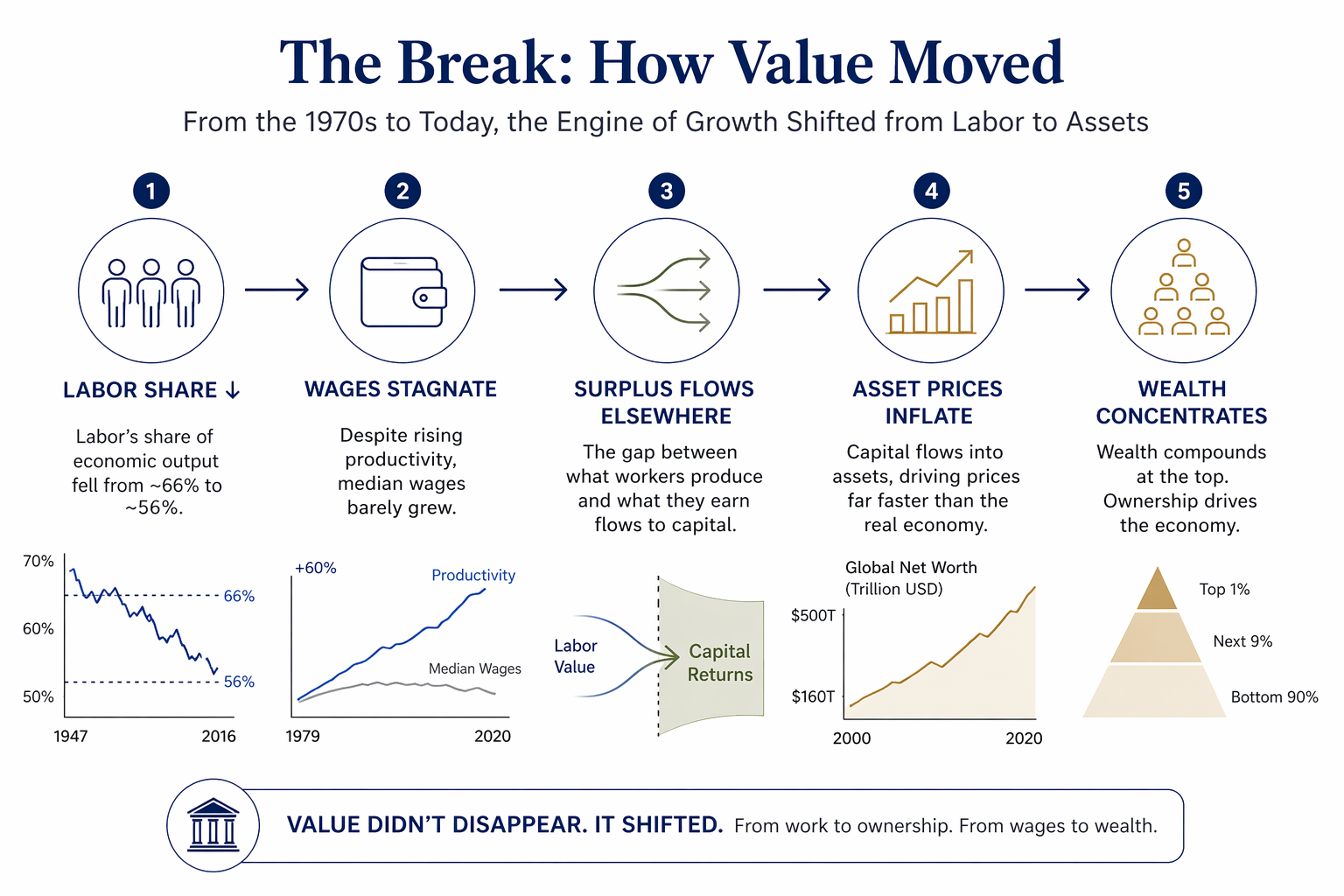
The underlying mechanism is mathematical. The French economist Thomas Piketty named it most precisely: when the rate of return on capital (r) exceeds the rate of economic growth (g), inherited and accumulated wealth dominates earned wealth, and inequality accelerates by structural necessity. For most of human history, r > g was the normal state of affairs. The mid-twentieth century was a historical exception, produced by the unusual conditions of the post-war moment. We have now returned to the historical norm. The math is not anyone's fault. It is the operating condition of an economy in which assets compound faster than wages — and the implications cannot be addressed through wage policy alone.
Artificial intelligence is now accelerating this dynamic, not reversing it. The current generation of AI is not creating a new economic paradigm. It is amplifying the existing one. The productivity gains from AI are flowing to the people and institutions that own the AI infrastructure, not to the workers whose labor is being replaced or augmented by it. The same pattern that played out with previous technological waves — the gains accruing primarily to capital, the costs falling primarily on labor — is now playing out at unprecedented speed and scale. Without a different ownership structure, the AI transition will accelerate the concentration trends already underway.
This is the structural condition the United States is now living in. It is not a policy failure. It is not the fault of either political party. It is the predictable consequence of running a twenty-first-century economy on a twentieth-century workaround in the absence of any deeper governance architecture.
And the democratic stakes are real. Democracies do not survive indefinitely on top of economies that concentrate wealth, hollow out the middle class, and leave most citizens economically precarious. The democratic strain visible in American politics today — the polarization, the institutional distrust, the appeal of authoritarian alternatives on both left and right — is not separable from the economic conditions that produced it. The political and economic systems are connected. Each depends on the other. A democracy that cannot deliver broad-based prosperity loses legitimacy. An economy that cannot operate within democratic constraints undermines the institutional foundations it depends on for property rights, contract enforcement, public investment, and social stability. The current trajectory weakens both.
The work of our time is to build an economy that strengthens democracy rather than weakening it — an economy that pairs profit with purpose, that broadens ownership rather than concentrating it, and that produces prosperity that compounds across generations rather than extracting it from them. This is not a rejection of capitalism. It is the application to economic life of the same insight the Founders applied to political life: that power, left without governance, concentrates in ways that threaten liberty, and that durable freedom requires durable structures of accountability.
The Shared Prosperity Model is one attempt to develop that governance architecture. It is grounded in a thesis that has been forming, in different forms, for more than a generation: that the next stage of American economic development requires a shift from redistribution — letting concentration happen and trying to correct it afterward through taxation and transfer — to predistribution, embedding broad-based ownership into the structure of economic activity before extraction occurs.
Predistribution addresses the source.
Both have a role; the missing piece in the current system is the predistributive layer.
Predistribution is not a new idea. It runs through American economic thought from Hamilton's argument for broadly held capital, through the homestead movement, through the employee stock ownership plans pioneered by Louis Kelso, through the cooperative movements that built much of rural electrification and agricultural infrastructure. What is new is the recognition that the next economic era — the era of platforms, data, and increasingly autonomous capital — requires predistributive design as a structural feature, not as an occasional policy intervention. The mathematics of r > g will not bend through redistribution alone. They bend when ownership itself broadens.
The Shared Prosperity Model also rests on a second commitment, less often named: that the institutions, enterprises, and economic structures we build should be designed for the heterogeneous middle of the population rather than optimized for the high-performing few. Most American institutions — schools, businesses, capital markets, philanthropy — are organized around the assumption that 80 percent of outcomes are produced by 20 percent of inputs, and that systems should therefore optimize for the top 20 percent. Taken individually, each application of this logic looks reasonable. Aggregated across an entire economy, it produces a system that is structurally indifferent to the broad middle and the bottom — to most of the people whose lives depend on the system functioning. The Shared Prosperity Model inverts this orientation. It treats designing for the heterogeneous middle not as an act of charity but as the foundation of durability. A system designed for the bell curve is more stable across cycles than a system designed for the tail. The case is structural before it is moral.
What Would a World Focused on the 80% Look Like?
The top 1% controls most wealth, while inequality deepens.
Prioritize the middle 80% through new ownership models, shift income tax to asset tax, and support for small businesses.
A stronger middle class, reduced inequality, and a more resilient economy.
Elite schools and top students receive most resources, leaving the majority underserved.
Equitably distribute resources, fostering diverse learning styles and supporting workforce development for the middle 80%.
Better learning outcomes, a more adaptable workforce, and reduced inequality.
High-cost treatments dominate, while preventive care is neglected.
Prioritize preventive, affordable healthcare for the majority.
Healthier populations and reduced overall healthcare costs.
Large corporations dominate, stifling small businesses.
Support decentralized, cooperative business models that empower small and medium enterprises.
Diverse markets, innovation from local businesses, and a more sustainable economy.
Wealthy elites dominate political influence.
Empower the middle 80% through political reforms and inclusive governance.
Policies that reflect broader public needs and more active civic participation.
The top 20% of corporations are the largest polluters, while climate change disproportionately harms the underserved.
Invest in community-driven climate solutions, prioritize sustainable practices for small and medium enterprises, and support green infrastructure.
A more climate-resilient society, reduced environmental impact, and equitable access to sustainable resources for the middle 80%.
These two commitments — predistribution as operating logic, and designing for the middle as orientation — together form the foundation of the Shared Prosperity Model. They are not yet a finished architecture. They are a thesis, fully developed at the conceptual level, that is now being tested in practice across three lanes of active work: in industry, where we are exploring how major economic investments can be designed for community ownership rather than retrofitted afterward; in entrepreneurship, where we are supporting founders through the structural ownership transitions that determine whether they accumulate wealth or remain operators of fragile businesses; and in education, where we are developing the civic and economic literacy that ordinary citizens need in order to hold the system accountable.
This is the work of our time. It is not finished. It is not even mostly built. But the thesis is real, the body of work behind it is real, and the partners who are joining this work are real. The invitation of this site is to engage with the thesis, examine the work, and — if the alignment is there — to find ways to build together.
The question is whether it will concentrate power further or broaden it.
The Shared Prosperity Model is one effort to ensure that the next economy strengthens the democracy it depends on, rather than continuing to weaken it.